Coursework Projects
Long-Endurance Communications UAV
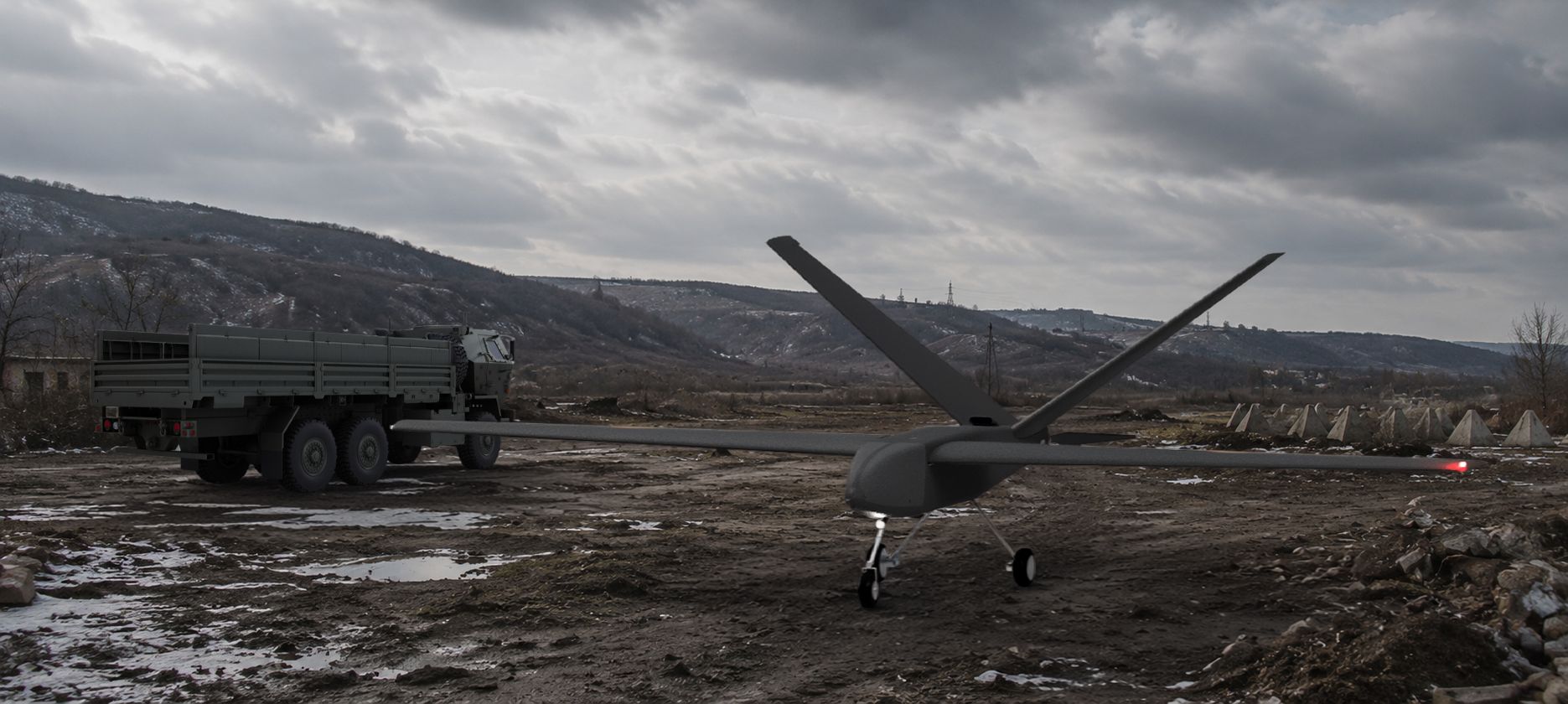
Part of an 8-engineer team delivering a full lifecycle design for a high-altitude, long-endurance communications UAV. The aircraft was developed to provide rapidly deployable communications coverage in network-denied areas, including remote emergency zones and disputed environments.
Project Poster
Key Details
- Date: 2025-Present
- University: Swansea University
- Module: EGA302A Final Design Report
- Team: Clank Air - Group 2
- Role: Aircraft Performance, Propulsion and Control Systems
- Aircraft type: High-altitude long-endurance communications UAV
- Mission: 24-hour communications relay at 30,000 ft
- Payload: 15 kg communications payload
- Electrical requirement: 1 kW continuous communications power
- Estimated MTOW: approximately 300 kg
- Configuration: high-aspect-ratio wing, V-tail and pusher propulsion layout
Overview
This project focused on the conceptual, preliminary and detailed design of a reusable long-endurance UAV intended to act as an airborne communications relay.
The aircraft was designed around a demanding mission profile: climb to 30,000 ft, cruise or loiter for 22 hours, descend safely, and provide continuous electrical power to a 15 kg communications payload throughout the main mission phase.
The brief required a 3600 km still-air range, 24-hour minimum endurance, operation from a general aviation airfield, a take-off distance below 1300 m, 1 kW of continuous payload power, reusability, rough-terrain suitability, removable wings and a maximum airframe cost of £1,000,000. The aircraft also needed to fit within a 6 m by 2.5 m truck bed, strongly influencing the wingspan and packaging strategy.
Mission Requirements
- Operate from a typical general aviation airfield.
- Take-off distance not to exceed 1300 m.
- Still-air range of 3600 km.
- Minimum endurance of 24 hours.
- Minimum operating altitude of 30,000 ft above mean sea level.
- Carry a 15 kg communications payload.
- Provide 1 kW continuous electrical power for communications during cruise.
- Reusable aircraft.
- Maximum cost of £1,000,000 per airframe.
- 15 minute turnaround time.
- Fit within a 6 m × 2.5 m truck bed for transport.
- Suitable for rough-terrain operations.
- Removable main wings.
Concept Selection
The chosen aircraft concept used a high-aspect-ratio main wing, V-tail, pusher propeller and hybrid propulsion system. The high-aspect-ratio wing was selected for efficient loiter and reduced induced drag during the long cruise phase, which represented over 90% of the mission duration.
The V-tail reduced wetted area, drag and structural complexity compared with a conventional tail while still providing pitch and yaw control through combined ruddervator surfaces. A pusher configuration kept the nose area clear for the communications package, reducing interference around the payload and improving airflow over the forward fuselage.
Aerodynamics
A key part of the detailed design was aerofoil selection for efficient high-altitude, low-Reynolds-number operation. NACA 4412, DAE-11, FX 63-137 and SD7037 were compared, with SD7037 selected for its balance of lift, drag, stability and reliable long-duration cruise performance.
A SwanVLM analysis was used to validate the 3D wing behaviour. It showed near-linear lift increase over the tested angle-of-attack range, favourable spanwise lift distribution and reduced loading toward the tips.
At 30,000 ft and 42 m/s, the calculated lift coefficient was approximately 0.455. The induced drag coefficient was approximately 0.0086, with total drag coefficient approximately 0.0292 and estimated whole-aircraft lift-to-drag ratio approximately 15.58.
Propulsion and Power
The propulsion system was sized around the cruise power requirement, 1 kW communications payload and additional avionics loads. The selected engine concept was the UAVHE RW1-300C, a 62 hp engine with an 11 kW electrical output.
The communications payload required 22 kWh of energy across the cruise phase. Because the engine could supply the payload electrically during cruise, a backup battery was included for emergency communications endurance. A 2 kWh battery was estimated to deliver around 1.44 kWh usable energy after efficiency losses, giving approximately 86 minutes of backup communications operation at a 1 kW payload draw.
Structures and Materials
The structure used a lightweight semi-monocoque philosophy with formers, frames, stringers and stressed composite skin. This approach provided efficient load transfer, useful internal volume for avionics and payload packaging, and reduced structural weight compared with bulkier truss or geodetic concepts.
CFRP sandwich construction was selected for the primary wing and tail structures, while GFRP sandwich construction was selected for the fuselage shell and RF-sensitive areas because of its radio-frequency transparency. Aluminium alloys were used for brackets, frames and high-load fittings.
- Specific stiffness
- Fatigue resistance
- RF transparency
- Manufacturing cost
- Environmental resistance
- Low-temperature operation at altitude
Landing Gear and Operations
A tricycle landing gear configuration was selected to provide stable ground handling and sufficient propeller clearance for the rear-mounted pusher propeller. The aircraft was intended to operate from typical general aviation airfields while remaining suitable for rougher terrain than a purely runway-optimised design.
Take-off and landing performance were analysed using ground roll, transition and obstacle-clearance calculations. The estimated take-off distance was below 500 m, within the 1300 m design requirement, and the total landing distance was estimated at approximately 524 m.
Testing and Validation
The design was validated through analytical sizing, aerodynamic modelling, flight simulation and scale-model development. Flight simulator testing checked whether the aircraft could operate within the required flight envelope and complete the intended mission profile.
The project also included costing, FMEA and risk assessment work to assess feasibility beyond pure performance, treating the final design as a complete aircraft system rather than only an aerodynamic concept.
My Contribution
My main contribution was within aircraft performance, propulsion and control systems. This included supporting mission-level performance analysis, aircraft sizing logic, propulsion system selection, endurance validation and control-system considerations.
I also contributed to the wider design process through concept selection, configuration trade studies and integration of the final aircraft package.
Key Metrics
Endurance
26.9 hours
Estimated endurance against a 24-hour mission requirement.
Cruise Altitude
30,000 ft
Designed for high-altitude communications relay operation.
Payload
15 kg
Communications payload with 1 kW continuous power demand.
MTOW
~300 kg
Preliminary sizing result for the final aircraft concept.
L/D
15.58
Estimated whole-aircraft lift-to-drag ratio in cruise.
Take-off Distance
<500 m
Estimated take-off distance, below the 1300 m requirement.